USDA Domestic Hemp Production Program (7 CFR Part 990)
Reference and portal tools for licensed producers under the USDA Domestic Hemp Production Program (7 CFR Part 990, Final Rule effective March 22, 2021).
Portal tools help organize crop records. They do not replace FSA filings, crop insurance agents, lab testing, or agency paperwork. Verify current rules on official USDA sources.
What Is Industrial Hemp?
Hemp (or industrial hemp) denotes Cannabis sativa cultivars grown for industrial and consumable products — not drug-type cannabis. Along with bamboo, hemp is among the fastest-growing plants on Earth; humans have spun usable fiber from hemp for an estimated 50,000 years. Overview: Hemp (Wikipedia). Use the section links above for fiber, papermaking, oil, and hempcrete on this page.
Chemotype I (high-THC) cannabis and industrial hemp (types II–V) are the same species but distinct cultivar groups with different phytochemistry and end uses. Hemp typically carries lower total THC and may have higher CBD. Under the U.S. USDA program, hemp is defined as cannabis with ≤0.3% delta-9 THC (with total THC testing and measurement of uncertainty under 7 CFR Part 990 for compliance lots). Legality and THC thresholds vary by country.
Hemp refines into paper, rope, textiles, clothing, bioplastics, paint, insulation, biofuel, food, and animal feed — among many other products. Europe's largest hemp producer as of 2022 is France (Brittany and other regions), where fiber still feeds specialty paper, textiles, and construction markets.
Textiles, rope, cordage, blended fabrics, specialty papers, hempcrete, insulation panels, biocomposites. Common VAPG value-added examples — document your own plans in the Business Grants workspace.
Animal bedding, mulch, hempcrete blocks, particle board, and pulp for paper and packaging. Often tracked as coproducts in grant budgets and lot records.
Food, pressed oil (culinary, cosmetics, paint binders), meal for animal feed. See hempseed oil compliance overview. Germination & genetics lots tracked in portal forms when producing licensed seed or propagation material.
Non-compliant or end-of-cycle biomass flows through USDA-aligned waste, remediation, and destruction documentation — Waste module, manifests, and compliance bundles in the client portal.
Etymology note: English hemp traces through Old English hænep from Proto-Germanic forms related to Greek kánnabis and cognates across Germanic languages (German Hanf, Dutch hennep, etc.) — reflecting millennia of fiber and oil use before modern chemotype breeding. See Etymology of cannabis (Wikipedia).
Hempseed Oil — Licensed Grain End-Use
Hempseed oil is pressed from licensed industrial grain-type hemp — food, cosmetics, and coproduct meal where state and FDA rules allow. It is distinct from high-THC flower cultivars and from fiber-only stands harvested before seed set.
7 CFR Part 990: Pre-harvest sampling, total THC testing, and compliant disposal if a lot exceeds the statutory hemp threshold. Document variety, planting, harvest moisture, crush batch, and COAs in the portal — not on this public overview.
- Confirm cultivars on your state or tribal approved list before ordering certified seed.
- Grain crush for food-grade oil uses Type III–V chemotypes — not CBD flower lines.
- Variety selection, trial yields, soil programs, and farm automation details stay inside licensed producer accounts — they are not published on this public overview.
Log lots in the Hemp Compliance workspace. General industrial hemp background: FDA hemp seed GRAS.
Hemp Fiber, Bast & Rope
Bast fiber (phloem in the outer stem) is the long, strong strand used for rope, cordage, textiles, and specialty papers. After decortication, the woody hurds remain for paper pulp, hempcrete, and bedding. Background: Bast fiber, Rope, Retting.
- Hemp was a standard naval and colonial cordage crop; fiber hemp is still cultivated at scale in France and the EU for textiles, paper, and construction coproducts.
- Retting (field, water, or enzymatic) separates bast from hurds before hackling, spinning, and braiding into labeled rope lots — each step logged in the client portal for CoC and grant milestones.
- Grant planning: value-added hemp rope is a common VAPG narrative; hurds from the same lots can support paper or hempcrete milestones in your application — use the Business Grants workspace to track evidence, not eligibility.
Log harvest, retting, and processing steps in the Hemp Compliance workspace when they apply to your lots. USDA lot compliance · Business grants.
Hempcrete (Hemplime) — Building & Insulation
Hempcrete (also hemplime) is a biocomposite made from hemp hurds (shives), a lime-based binder (hydrated or natural hydraulic lime), water, and sometimes sand or pozzolans. It is used for insulation, non-load-bearing infill walls, finishing plasters, and prefabricated blocks — marketed under names such as Hempcrete, Isochanvre, and IsoHemp. Overview: Hempcrete (Wikipedia).
- Cast-in-place: forms on site — hemp hurds, lime binder, and water mixed and placed between timber or steel framing.
- Prefabricated blocks: stacked like masonry, then finished with plaster or drywall.
- France & Canada: widely used since the 1990s for non-weight-bearing insulating infill; also roof, wall, slab, and render formulations.
- Not structural: compressive strength is typically low (~0.3 MPa) — walls must be supported by a frame; hempcrete is ~15% the density of conventional concrete.
Strong thermal and acoustic insulation; high vapor permeability acts as a moisture regulator (absorbs and releases humidity). Combines insulation with thermal mass in many climates.
Fire-resistant insulating material; resists mold and cracking without concrete-style expansion joints. Hemp absorbs CO₂ while growing; lime carbonates over time — prefabricated blocks can act as a carbon sink across their service life.
U.S. adoption is growing but codes are still maturing. The Hemp Building Foundation submitted paperwork to the International Residential Code (IRC) in February 2022 to recognize hempcrete as a national building material. Local permits may still apply for hemp in construction — verify with your building official.
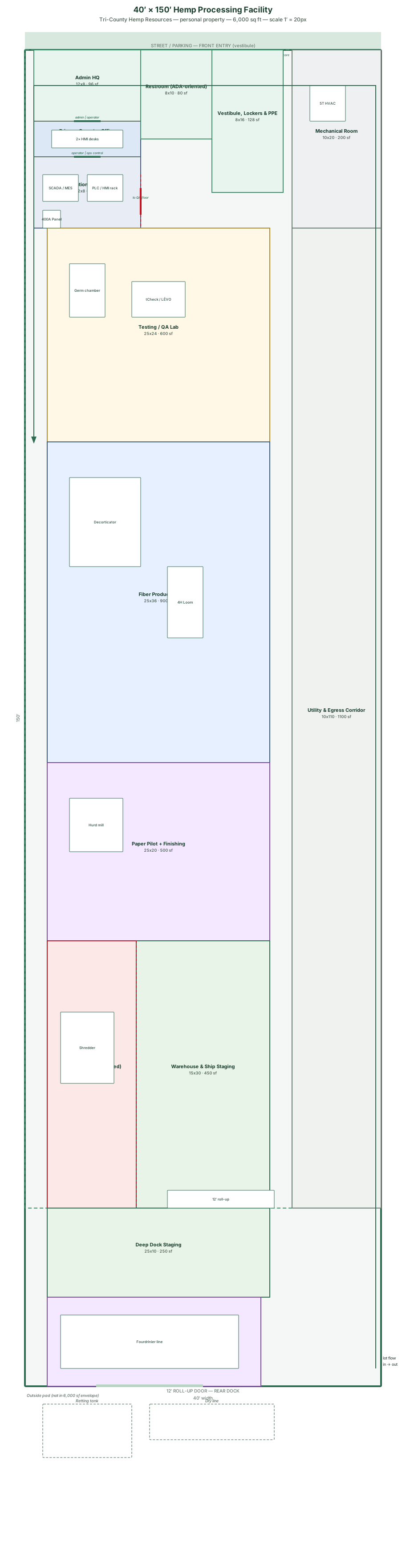
Facility planning note: the diagram below is an example layout for grant and compliance planning — not an offer to build, operate processing equipment, or sell hempcrete products. Use the portal to log lots and grant milestones if they apply to your operation.
Conceptual visualization of an insulated metal processing building — not a built facility and not an offer to construct.
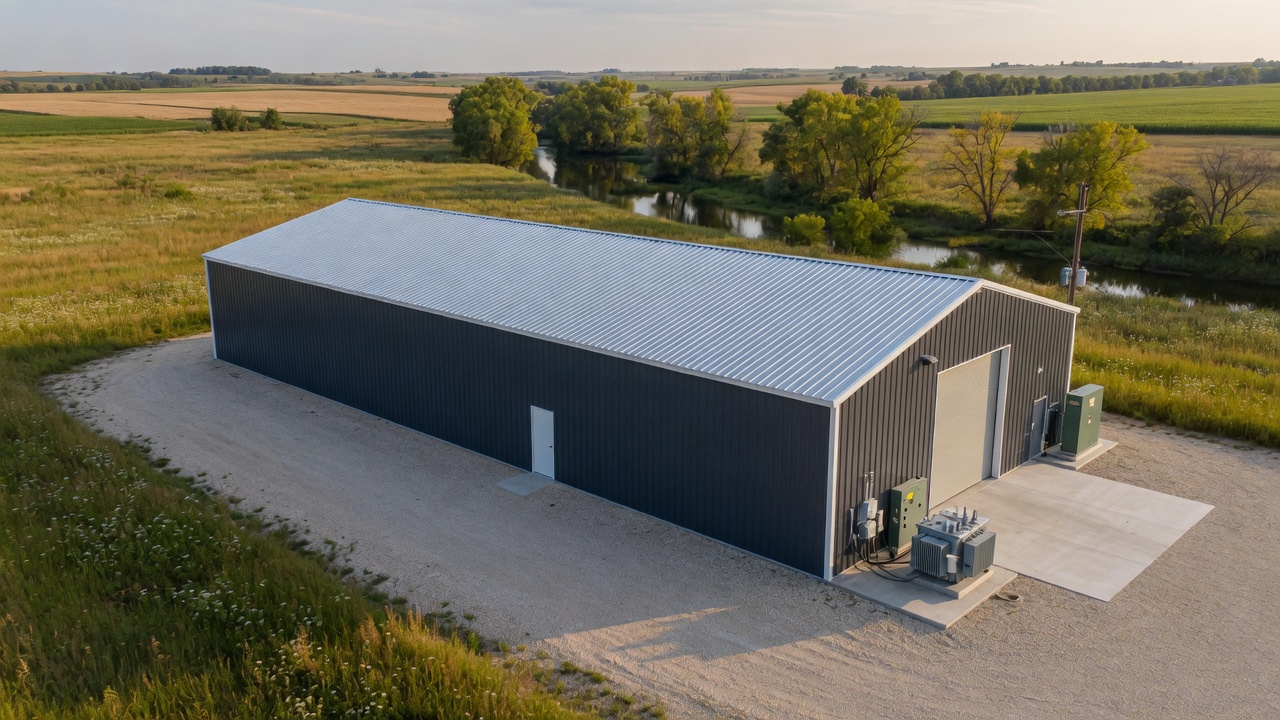
Clear-span PEMB (no interior columns) — dashed outline shows preserved 30×130 core; 10′ utility wing, mechanical room, deep dock, and Fourdrinier annex in the expansion envelope.
References: Wikipedia: Hempcrete; Allin, S. (2005) Building with Hemp (Green Building Press); NNFCC / biocomposites hemp-lime factsheet (PDF); Niyigena et al. (2016) mechanical properties of hemp concrete; Jami et al. (2019) hemp concrete for green building. Wikipedia article incorporates CC BY 4.0 text from Bourbia et al. (2023) on hempcrete (see Wikipedia references).
Foundational Federal Hemp Laws (Historical Timeline)
Hemp was historically encouraged in colonial America for fiber, rope, and other uses, but federal law began restricting cannabis in all forms — including industrial hemp — in the early 1900s. Until the 2010s, hemp was often not distinguished from marijuana. The five laws below trace that shift from early 20th-century regulation to 21st-century federal authorization for commercial hemp production. More recent 2025–2026 legislation has introduced further changes to hemp-derived cannabinoid products (e.g., total THC limits); always verify current rules on official USDA and AMS sources.
The earliest federal law addressing cannabis (including hemp-derived products). It required accurate labeling of drugs containing cannabis, opium, cocaine, and similar substances in interstate commerce to prevent misbranding or adulteration. Cannabis remained legally available if properly labeled, but this act laid the groundwork for federal oversight of hemp and cannabis in consumer products.
The first major federal legislation specifically regulating cannabis in all forms, including industrial hemp. It imposed a tax and registration requirements on anyone importing, producing, selling, or dealing in marijuana or hemp. While not an outright ban, the burdensome compliance effectively halted most commercial hemp production and importation.
Classified marijuana — which at the time included all cannabis varieties, including low-THC hemp — as a Schedule I controlled substance with high potential for abuse and no accepted medical use. This broadly prohibited cultivation, possession, and distribution, severely restricting hemp for decades.
Authorized state-regulated pilot programs for the cultivation and study of industrial hemp by universities and state agriculture departments. This was the first modern federal step toward distinguishing and supporting hemp research and production (defined as cannabis with ≤0.3% delta-9 THC).
Fully legalized commercial hemp production at the federal level. It removed hemp (cannabis with ≤0.3% delta-9 THC) from the Controlled Substances Act definition of marijuana, established USDA oversight, and enabled interstate commerce of hemp and hemp-derived products (such as CBD). The USDA Domestic Hemp Production Program and 7 CFR Part 990 (below) implement this framework.
References: Pure Food and Drug Act of 1906; Marihuana Tax Act of 1937; Controlled Substances Act (DEA overview); Agricultural Act of 2014 (Farm Bill); Agriculture Improvement Act of 2018 (Farm Bill); USDA Final Rule (2021).
Hemp Papermaking — History & Fiber Science
Hemp paper is paper made wholly or largely from pulp of industrial hemp fibers. Today it is mainly a specialty grade — cigarette paper, banknotes, technical filter papers, and premium writing or packaging sheets — though commodity blends are growing. Compared with wood pulp, hemp offers four to five times longer fibers, lower lignin, and higher tear resistance and tensile strength; modern mills optimized for wood still make hemp pulp costlier at scale.†
Long before modern USDA licensing, hemp fiber underpinned one of humanity's most important technologies. Value-added hemp paper remains a common grant narrative — from ancient East Asia through 20th-century USDA research to today's compliance-tracked production lots. Document your own plans in the Business Grants workspace; we do not operate a paper mill or sell pulp products. Overview and citations: Hemp paper (Wikipedia).
The first identified coarse paper made from hemp dates to the early Western Han dynasty — roughly 200 years before the nominal invention of papermaking credited to Cai Lun, who improved and standardized paper production using inexpensive materials, including hemp ends, around two thousand years ago.1
Recycled hemp clothing, rags, and fishing nets were commonly used as inputs for paper production — an early form of fiber recycling that turned worn textiles and cordage into writing stock.2
By the sixth century AD, the papermaking process had spread to Korea, where cannabis had been used for thousands of years, and to Japan, where cannabis had been used for an estimated 10,000 years.3
In 1916, U.S. Department of Agriculture chief scientists Lyster Hoxie Dewey and Jason L. Merrill published USDA Bulletin No. 404, Hemp Hurds as Paper-Making Material. They concluded that paper from hemp hurds was “favorable in comparison with those used with pulp wood.”5 The chemical composition of hemp hurds is similar to that of wood,7 making hemp a strong raw material for manufacturing paper. Peer-reviewed work continues to compare wood vs. hemp cellulose pulps for papermaking potential.24† Dewey's later survey of western-hemisphere fiber production (1943) does not discuss hemp as a paper feedstock — reflecting how federal policy and industry focus had shifted by mid-century.8
- Cellulose: dried hemp has about 57% cellulose (the principal ingredient in paper), compared to roughly 40–50% in wood.10
- Lignin: hemp contains only 5–24% lignin versus 20–35% in wood.13 Lignin must be removed chemically; wood typically requires more chemical processing than hemp hurds.15
- Fiber length & strength: hemp bast fibers run 4–5× longer than typical wood fibers, with higher tear resistance and tensile strength — advantages for specialty and durable sheets.†
- Stem anatomy: only about 25% of the dried hemp stem (the bark / bast) is long, strong fiber ideal for fine paper; hurds (shiv) feed pulp lines and value-added coproducts — matching Tri-County's rope → hurd → paper workflow.29
Hemp paper reached Europe in the 13th century via the Middle East; Germany adopted it in the 14th century. Before industrial wood-pulp mills (from the 19th century), paper relied on recycled textile rags — hemp, linen, and cotton — with deinking methods dating to 1774. Commercial wood pulp (1843) shifted mass production away from hemp rags.20
The St. Petersburg Goznak paper mill (opened 1818) used hemp as its main feedstock for banknotes, stamped paper, bonds, postal stamps, and other watermarked security papers.4
For fiber hemp destined for decortication, hurd pulp, and automated paper lines, harvest timing directly affects fiber quality and yield. Dioecious fiber crops are typically cut when male plants finish flowering — late August to early September in the northern U.S. (about 70–100 days after planting).25 Wisconsin field work documented late-August fiber harvests;27 North Dakota trials reported fiber dry-stalk yields harvested in early August.28
Tri-County practice: log harvest date, lot ID, and hurd disposition in the client portal (Planting/Harvest forms, Daily Ledger, Documents) so value-added paper production stays traceable under 7 CFR Part 990 recordkeeping — supporting VAPG milestones, CoC, and audit bundles.
Actual U.S. hemp fiber production continued to decline until 1933 (to around 500 tonnes per year). Between 1934 and 1935, cultivation began to increase again, but remained at very low levels with no significant rise in paper made from hemp.16
After the Second World War, industrial hemp was grown only on micro-plots in the U.S. Although hemp bred in the 1950s and 1960s almost completely lacked THC, cultivation was banned in many countries in recent decades. In Germany, growing hemp was prohibited entirely between 1982 and 1995 under the Narcotic Drugs Act to prevent illegal cannabis use as a narcotic.
France was a notable exception: varieties used for cigarette paper remained in cultivation. As of 1994, most of the French hemp crop went to rolling paper, currency, and high-quality Bible paper (India paper).18 In Europe, hemp fiber for paper was ~90% of legal hemp use in the 1990s; cigarette and specialty grades still dominate many EU markets today.30
Hemp pulp remains a niche (~0.05% of world pulp volume in the early 1990s) because few Western mills run at wood-mill scale and hemp is harvested once per season (August storage/handling adds cost). Literature often cites hemp pulp at ~5–6× the cost of wood pulp where infrastructure is underdeveloped — which is why Tri-County targets automated, on-site hurd pulping paired with fiber decortication rather than commodity copy paper alone.23
- Faster crop cycle (~3–4 months to mature stalks) vs. decades for forestry feedstock
- Hemp pulp commonly bleached with hydrogen peroxide (fewer chlorine/dioxin concerns vs. some wood lines)
- Hemp paper can be recycled more times than typical wood-fiber sheets in cited comparisons
- Specialty uses: marketing print, stationery, packaging inserts, thin/security/filter grades
† Summary aligned with Wikipedia: Hemp paper (lead section & cited sources). Verify independently for grant or academic use.
Primary overview (footnotes align with Wikipedia citation numbers): en.wikipedia.org/wiki/Hemp_paper
- [1] Cai Lun Improved the Papermaking Technology (ChinaCulture.org, archived).
- [2–3] Clarke, R.; Merlin, M. Cannabis: Evolution and Ethnobotany (Univ. of California Press, 2013) — pp. 187–188.
- [4] St. Petersburg Paper Mill of Goznak (history, archived).
- [5–6] Dewey, L.H.; Merrill, J.L. Hemp Hurds as Paper-Making Material (USDA Bulletin No. 404, Oct. 14, 1916; p. 25).
- [7] Stevulova, N. et al. (2014). Properties Characterization of Chemically Modified Hemp Hurds. Materials 7(12), 8131–8150 (PMC).
- [8] Dewey, L.H. (1943). Fiber production in the western hemisphere (U.S. Govt. Printing Office), p. 67.
- [9–10] French, L.; Manzanárez, M. (2004). NAFTA & neocolonialism (Univ. Press of America), p. 129; Cellulose — Encyclopædia Britannica.
- [11] Chemical Composition of Wood (Georgia Tech IPST PDF, archived).
- [12–13] Piotrowski, S.; Carus, M. (2011). Multi-criteria evaluation of lignocellulosic niche crops (nova-Institut, archived).
- [14] Li, J. (2011). Isolation of Lignin from Wood (Saimaa Univ. of Applied Sciences).
- [15–20] Van Roekel, G.J. (1994). Hemp Pulp and Paper Production; Göttsching & Pakarinen, Recycled Fiber and Deinking (Fapet Oy, 2000), pp. 12–14 (rag/deinking history).
- [16–17] West, D.P. Fiber Wars: The Extinction of Kentucky Hemp; Anslinger, H.J. Additional Statement (Commissioner of Narcotics).
- [18–19] Carus, M.; Sarmento, L. (2016). The European Hemp Industry (EIHA PDF); Girouard, P. (1994). Insights of the French Hemp Program (REAP Canada / McGill EAP), p. 5.
- [23–24] Van Roekel (1994); Anatomy of a Modern Paper Mill (Lakehead Univ.) — pulp scale & cost context.
- [25–26] Kaur, G. et al. (2025). Harvesting Industrial Hemp: General Considerations (MU Extension); WERA1056: Hemp Pest Management and Production in the Western USA (NIMSS).
- [27] Exploration of Hemp for Fiber Production and Quality in Wisconsin (UW–Madison Extension, 2023), p. 2.
- [28] Hanson, B.K. et al. (2018). Industrial Hemp Variety Performance in North Dakota (NDSU Langdon REC), p. 1.
- [29–30] Nonwood Alternatives to Wood Fiber in Paper (Boise Cascade, archived) — bast fraction; Carus et al. (2008) EU natural-fiber market study.
- [24†] Małachowska, E. et al. (2015). Comparison of papermaking potential of wood and hemp cellulose pulps. Ann. Warsaw Univ. Life Sci. — Forestry and Wood Technol. 91:134–137.
General sources: Small, E. (2016). Cannabis: A Complete Guide (CRC Press); Small, E.; Marcus, D. (2002). Hemp: A New Crop with New Uses (ASHS Press); Karus, M. (2005) European hemp industry trends (EIHA, archived); Bócsa, I.; Karus, M.; Lohmeyer, D. (2000) Der Hanfanbau; Canadian Hemp Trade Alliance — Hemp Fibre Production & Harvest Management guides.
Key Requirements for Hemp Producers (7 CFR Part 990)
A valid license is required before producing hemp. Under the USDA plan (for states/tribes without an approved plan), apply via the Hemp eManagement Platform (HeMP). Licenses are valid for 3 years. Key participants must provide a recent FBI criminal history report. A 10-year bar applies for certain controlled substance felony convictions (with limited pre-2018 exception for lawful growers under the 2014 Farm Bill).
Report hemp crop acreage to your local USDA Farm Service Agency (FSA) office within 30 days of planting. Provide: street address + geospatial location (or legal description) for each lot/site, acreage or indoor square footage, and your license number. FSA assigns official lot IDs (farm/tract/field/subfield). Annual reporting is also required. Our lot forms and wizard are designed to help capture and organize this data for your FSA submissions.
Find your local FSA office: FSA Office Locator. If you see redirect loops on the USDA site, clear cookies for *.usda.gov or try incognito/private mode.
- Samples must be collected no more than 30 days prior to the anticipated harvest.
- Samples must be collected by an authorized sampling agent (producers may not collect their own compliance samples).
- Samples are taken from the flowering tops of the plants: cut the top 5 to 8 inches from the main stem (including leaves and flowers), terminal bud, or central cola of the flowering top.
- The sampling method must provide 95% confidence that no more than 1% of the plants in the lot would exceed the acceptable hemp THC level (or use an approved performance-based method).
- A representative of the producer should be present during sampling if possible. Sampling agents must have full access to the premises and plants.
- Do not harvest the crop prior to samples being taken.
Our Forms page includes structured CropTesting and Harvest reports to document these details for your records.
Testing must use post-decarboxylation or other similarly reliable methods approved by the Secretary to determine total delta-9 tetrahydrocannabinol (total THC) concentration on a dry weight basis. Total THC accounts for the conversion of THCA to THC: THC + (0.877 × THCA).
Laboratories must report the Measurement of Uncertainty (MU) with results. The acceptable hemp THC level is met when the MU applied to the reported total THC produces a range that includes 0.3% or less.
Our CropTesting form type captures lab name, DEA registration, test date, total THC dry weight, MU, test method, and status (compliant / non-compliant / pending disposal). USDA notice (Dec. 23, 2025): enforcement of the DEA-registered laboratory requirement is delayed through December 31, 2026 — labs not yet DEA-registered may still test hemp until then if they meet all other AMS requirements. Labs pursuing registration use DEA Form 225 online application (analytical laboratory) via the Diversion Control Division registration hub; existing registrants sign in at the DEA online registrant login.
Cannabis that tests above the acceptable hemp THC level is considered marijuana and must be disposed of or remediated. Producers must notify USDA of the intent and verify completion (typically via HeMP form AMS-27).
Disposal options (per USDA Remediation and Disposal Guidelines): Use a DEA-registered reverse distributor or law enforcement, or approved on-site methods such as plowing under, mulching/composting, disking, bush mowing, deep burial and covering with soil, or burning.
Remediation: (1) Remove and destroy non-compliant flower material while retaining stalks, stems, leaves, and seeds; or (2) shred the entire plants into a homogenous biomass and re-sample/re-test the biomass. Remediated material must be clearly labeled and separated until it passes re-testing. Re-sampling follows the same Sampling Guidelines.
Use our Waste & Lot Tracking and Documents sections to record disposal/remediation details, attach verification (photos, manifests), and maintain the required chain of custody.
Maintain records for at least three (3) years regarding land where hemp is produced, hemp plant acquisition, production, handling, storage, and disposal or remediation of non-compliant plants. Records must be available for inspection by USDA or authorized representatives. Full access to premises during business hours is required for inspectors.
Our Documents, Ledger, Waste tracking, and compliance bundles are built to support these 3-year retention and audit requirements.
Use HeMP for license management, disposal/remediation reports, and annual reports. Laboratories report compliance test results to HeMP. Producers under USDA plan also have specific reporting obligations. States and Tribes have monthly and annual aggregate reporting.
Negligent violations (e.g., failure to provide land description/FSA report, failure to obtain license, production of cannabis exceeding the acceptable level) require a corrective action plan. A producer may not receive more than one negligent violation per growing season. Three negligent violations in a 5-year period result in 5-year ineligibility. Violations with a culpable mental state greater than negligence must be reported immediately to the U.S. Attorney General and chief law enforcement officer. Materially false statements on applications make the applicant ineligible.
Official Resources (Always Verify Current Information)
- • USDA AMS Hemp Production (main program page, updates in progress notice, enforcement discretion)
- • Hemp eManagement Platform (HeMP) – Apply for USDA license, submit reports
- • 7 CFR Part 990 – Domestic Hemp Production Program (full codified regulations)
- • USDA Hemp FAQ
- • Sampling Guidelines for Hemp (PDF) and Laboratory Testing Guidelines
- • Remediation and Disposal Guidelines for Hemp Growing Facilities (PDF)
- • Find local FSA office: FSA Locator (clear usda.gov cookies or use incognito if you hit redirect loops).
- • DEA registration hub (Diversion Control Division) — overview, forms, and support for analytical laboratories (Form 225). Online: new application, registrant login, check application status. Support: 1-800-882-9539.
- • DEA-registered laboratory enforcement delay (Dec. 23, 2025 notice) — hemp may be tested by non-DEA-registered labs through December 31, 2026; laboratories must still comply with all other AMS testing requirements. Prior extension ran through December 31, 2025 (Nov. 14, 2024 notice).
This page was prepared based on the Final Rule and related USDA guidance. Rules and guidance can change. Review official sources regularly. Last reviewed against 7 CFR Part 990 and AMS materials: 2026-06.
Developer reference: source verification list in repo at docs/USDA_7CFR990_Sources_and_References.md. Live regulatory text: eCFR Part 990.
Looking for specific program contacts, FSA offices, certified sampling agents, or state coordinators?
Officials directory for paying subscribers in the client portal →